THE COMPLETE GUIDE
Hair fibers: what they are, how they work, and what to expect.
Hair fibers are temporary cosmetic camouflage for thinning hair. They can make areas with reduced density look fuller by adding colored microfibers around existing strands and reducing visible scalp contrast.
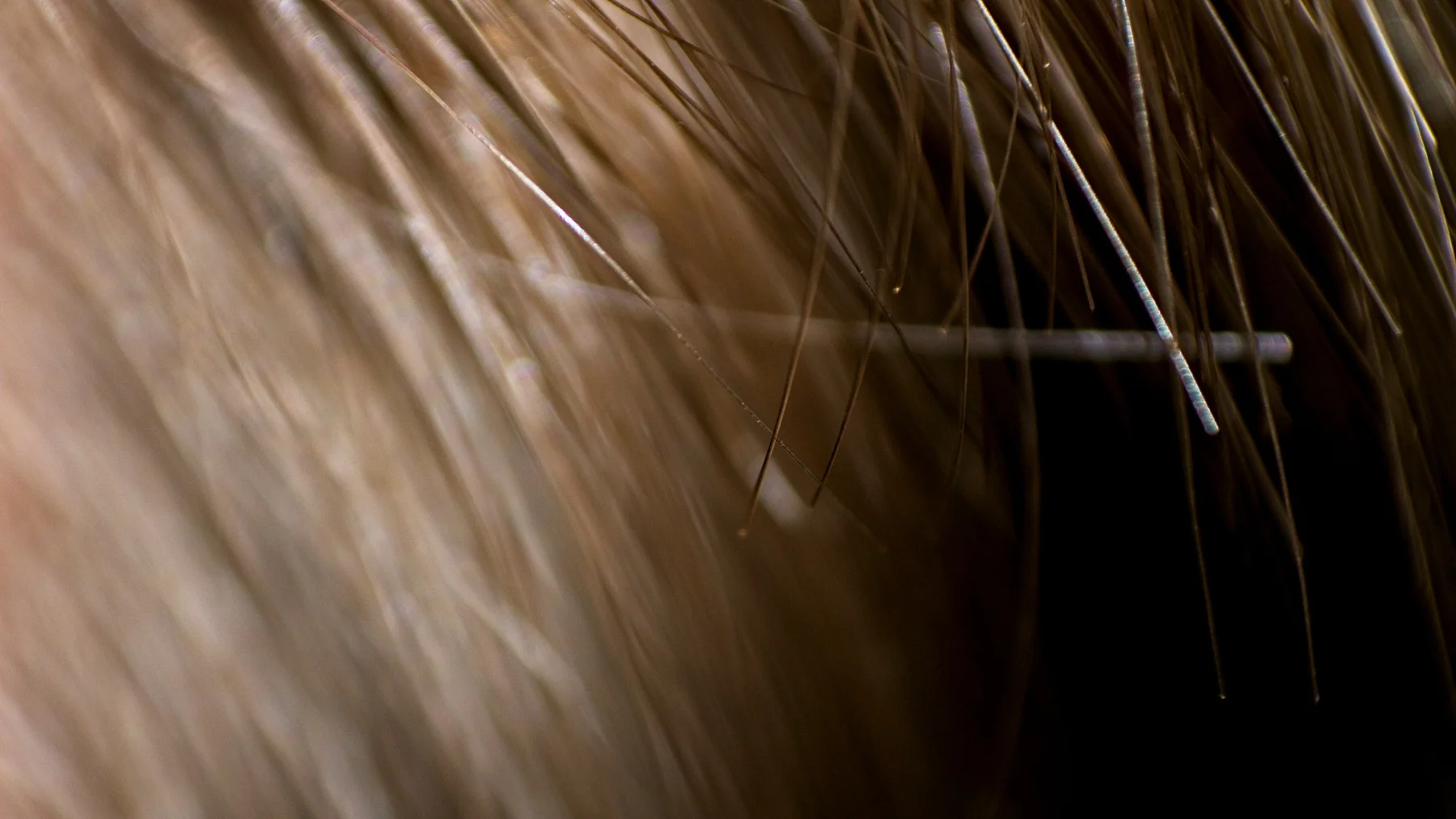
01 · BASICS
What are hair fibers?
Hair-building fibers are very small colored fibers designed to sit among existing hairs. Products can be made from keratin, cotton/cellulose, rayon or other fiber materials. Their job is visual: make individual strands appear thicker and make the scalp less obvious between them.
They are not a dye, transplant or medication. The effect is temporary and is normally removed when the hair is washed.
02 · MECHANISM
How do hair fibers work?
Research examining reconstructive hair fibers under scanning electron microscopy describes an electrostatic mechanism for some keratin products: charged fibers adhere to existing hair shafts. Other organic fiber materials can still produce a similar cosmetic effect even though their composition differs.
The visual result comes from two things happening together: more material around the existing strands and less contrast between the scalp and the surrounding hair.
03 · BEST USE CASES
Where do hair fibers tend to work best?
Usually a good fit
Crown thinning · widening parts · diffuse thinning · reduced density where plenty of short or fine hair remains.
Usually a weaker fit
Completely smooth bald areas · open wounds or irritated scalp · areas with almost no hair for loose fibers to attach to.
04 · SHADE
Shade match is part of the technology.
Published user studies consistently show color matching as an important part of satisfaction. Match the hair nearest the scalp rather than lighter ends, and judge the result in daylight. The goal is not to create a solid block of pigment; it is to reduce contrast.
Read the shade-matching guide →05 · LIMITS
What hair fibers do not do.
Hair fibers do not regrow hair, stop hair loss or treat alopecia. They are camouflage. Sudden, patchy, painful, inflamed or otherwise unexplained hair loss deserves medical evaluation rather than being hidden indefinitely with a cosmetic product.
06 · EVIDENCE
Does research support hair fibers?
Yes — for temporary cosmetic coverage and user satisfaction. Small clinical studies report improved perceived fullness, scalp coverage and confidence, with generally few adverse effects. The evidence base is still much smaller than it is for medical hair-loss treatments, and it does not establish regrowth.
Read the research